
The Meadow Brown or Maniola Jurtina is a common butterfly that most people wouldn't recognise. It lives out its life in the meadows and normally minds its own business. Though they are common we take no notice. They have no striking red bands like a red admiral and don't look as startling as a peacock. Despite this, in its own way the Meadow Brown is a beautiful creature. Should we only hold affection for the most beautiful things, or see the beauty in everything? This was a zoom shot as they would never let me get close with the bigascope.
Back to the bigascope then. The flowers are changing so quickly this time of year that I will have to include a flower section nearly every day just to keep up.

Today's flower of choice is the Dog Rose or Rosa Canina. These pink flowers can be seen on green bushes down most country lanes this time of year. It is funny really how the rose is considered "the" flower for romance. Its just a flower. It is a nice flower but not necessarily any more romantic then any other. I wonder why we attach meaning to nature like this?
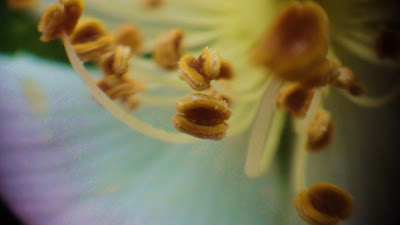 This photo is a close up of the flower's stamens. The name stamen refers to the male part of the plant and refers to most of the gubbings shown in this picture. Each of the composite bits does have a name though. The long stalks are called filaments and the brown heads are called anthers. The light toffee coloured edges on the anther are its microsporangia. Visible on the microsporangia in this picture are pollen grains that are no more than a couple of microns wide. Pollen grains are little hard balls that each contain two sperm cells.

The aim of the game is to get the pollen to stick to a passing bee. The bee then moves to the next flower carrying with it the pollen. The pollen will get stuck the stigma of the plant and release its sperm cells. How do you convince a bee to visit? The rose, like most flowers, provides the bee dinner. Around the Stigma is nectar, a sticky solution of sucrose, glucose and fructose that the bee mixes with its own saliva to make honey. Insect spit, Yum!

 Some of the fields are a blaze with this, the Common poppy (Papaver rhoeas).
 Here is a sign of the coming autumn, orange berries on the Lords and Ladies (Arum maculatum) plant. Believe me now?

